News
04/17/2026
Robotics Innovation Through Inclusion
Inside Poly’s Robotics Team with Kristin Guynn

Relaunched in 2020 under Director of Robotics Kristin Guynn‘s deft leadership, Robotics at Poly has grown into one of New York City’s most competitive and diverse programs: two teams and 30 members with many decorated awards and titles to its name, including The Innovate Award, The Control Award, and The Winning Alliance title. As part of the FIRST Robotics Competition, students spend the entire year working as a team to design, program, and build an industrial-sized robot to compete in an alliance-based challenge, a high-stakes endeavor that demands technical rigor, creative problem-solving, and deep collaboration. Guynn’s formula for success pairs rigorous technical training with intentional culture-building—creating opportunities for students at every experience level to learn, lead, and contribute. The result, by design, is a team that is both high performing and deeply inclusive.
From Representation to Real Impact
Guynn emphasizes that a range of perspectives are a key driver of innovation and high-performance in Robotics at Poly. By valuing both visible and cognitive diversity, teams are able to generate stronger ideas and exceptional results.
“Diverse thoughts always lead to a more advanced outcome when there is a meeting of the minds,” says Guynn. “As students see that in real time through hands-on experience, they are also seeing the research-backed value of diversity as one of the clearest markers of high-performing teams. It is not only about recognizing our varied identities in visible ways, but also our diverse minds. The many ways we bring diversity to the team are not just an advantage because they help us present a different picture; they also help us create more advanced technology because we have so many unique ideas to build upon.”
That inclusive structure has produced something truly aspirational. Representation shows up in day-to-day leadership and mentoring, and students learn from peer role models who lead the team with humility and high standards. This emphasis on social-emotional learning means the program doesn’t just teach wiring diagrams and code; it asks everyone to unlearn limiting narratives about who “belongs” in STEM, to practice growth-focused feedback, and to treat failure as a step toward mastery.
Diversity as Practice, Collaboration as Power
Competition seasons at Poly are designed to be collaborative, inviting many voices into the brainstorming process so that engineering becomes a collective decision-making exercise rather than a solitary pursuit. That collaborative approach to each step of the design process, along with Guynn’s research-backed belief that cognitive diversity produces stronger solutions, shows in more advanced, more resilient designs and in a culture where every idea is tested, questioned, and improved.

More than demographics, the diversity of students on the Poly robotics team is a deliberate strength that drives learning, leadership, and innovation. “We may be the most diverse team in New York City right now,” reflects Guynn, “and we are constantly owning, affirming, and celebrating that fact. In Robotics, we have a very diverse representation of leadership from students, and they have done such a powerful job. Students know they have peers who look all different ways and have taught them so much, guided them with kindness and humility, and led the team to continuous growth and success. There is nothing but respect and admiration for what someone who looks like them, leads like them, or sounds like them is capable of.”
Freedom to Become
A third-generation programmer, Guynn shares that she imbues a personalized approach to coaching and teaching through insights gained through her own experience. She enjoyed the freedom to choose her life’s passion based on interests and personality, not gendered expectations.
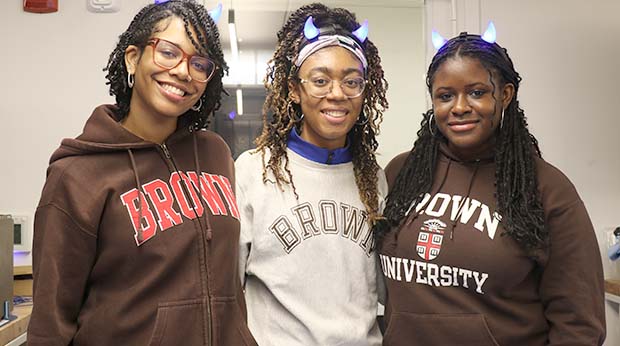
To date, the team celebrates the momentum of a legacy newly written: three consecutive team captains, three Black young women from underrepresented backgrounds in STEM, have matriculated to Brown University. And while the history of Poly students achieving their dreams and goals of admission to elite institutions is a wide-reaching network, Guynn says talks of colleges and universities remain separate from the Maker Space, home of the Robotics team. The team and the environment in which they work, provides respite from the pressures of college access.
Collaboration and Confidence Building
While students in Robotics gain important technical skills, they also learn leadership and social skills in an environment that requires patience and openness to new ideas. Guynn emphasizes that Robotics gives students a safe space to practice all. And while students may feel uncomfortable at first, they build the confidence and resilience that will serve them in the future.
“We doubled down on the idea that before you can build anything, you need to collaboratively come up with a design that fully reflects everyone’s input. There is a dialogue among all ideas and designs because there is no one right version—there is the version that we collectively decide on. That is the beauty of engineering. There is no single answer and learning that this is not only fair but also a strategy for success. It means brainstorming varied options and listening to different viewpoints, and understanding why someone chose a particular idea or design and what they were trying to achieve.”

The Role of the Robotics Captain
A robotics team captain takes on numerous roles and has different responsibilities baked into them. “It’s different from being a captain on a sports team, where you’re often leading by example but not necessarily responsible for your peers’ development,” says Guynn. “In the robotics program, captains take on roles as lead builders, supervisors, and managers. If a project isn’t managed well, it won’t get built—let alone function—so the stakes are high. It’s also a unique team environment, bringing together many different personalities, including students who may not have had prior experience working on a team.”
Unlearning Limiting STEM Narratives
At the program’s heart, it pairs rigorous technical instruction with intentional work on identity, confidence, and an inclusive classroom culture. She cautions against leaving internalized biases unaddressed, guiding students not to view misconceptions of differences as destiny. While some research shows changes in cognitive and social development around puberty, Guynn reflects that, in the United States, girls often do very well on middle school math assessments; the real turning point comes from social conditioning: how teachers give feedback, what behaviors are modeled, and which voices are amplified. Guynn describes herself as a passionate curriculum designer. She stays informed on the latest research about how young people learn and builds lessons and feedback systems that counteract the narrative about who succeeds in STEM.

Robotics asks everyone who enters the space to challenge and shed limiting assumptions about what is possible. That work looks like: prioritizing growth over innate talent; giving feedback that builds agency rather than policing mistakes; and creating opportunities for all students to lead, fail, iterate, and succeed publicly. Practically, this means scaffolding challenges so newcomers to the team aren’t left behind, elevating peer mentors who model both technical skill and fair, pragmatic leadership, and deliberately addressing the beliefs and expectations that can quietly narrow a student’s sense of possibility.
By treating social-emotional learning as part of the technical curriculum, the program turns STEM into a place where identity and skill develop together. Students learn not only how to solve problems, but how to see themselves as people who belong in the work.
The Magic of This Year’s Robotics Team
According to Guynn, this year stands out as perhaps the team’s strongest yet, not because of a single idea, but because student leadership’s insistence on giving building and design the airtime they deserved. The team collaborates well and shares in the full process of project development. There was a real, practiced dialogue around ideas, not to find one “right” answer, but to decide together which approach made the most sense. That consistent show of togetherness revealed blind spots, suggested improvements, and produced solutions that were more sophisticated than any single student might have imagined. This certainly helped them qualify for the NYC Championships once again and contributed to what has been the strongest competitive season in the program’s history.
They head to Lexington, Kentucky on Thursday, May 28, to compete in the First Tech Challenge (FTC) Premier Event, a capstone competition that brings together some of the highest-ranked teams in the world. Assistant Coach Dan Costello shares that after placing 6th at the NYC Regional Championships, Polymorphism earned its place on the national stage, where the team will showcase everything they’ve built and learned this season alongside top FTC teams globally.
Excellence Meets Empathy

Looking ahead, Guynn wants the next generation of leaders to carry forward a crucial balance: power paired with humility. As the team gains reputation and responsibility, the danger is that leadership becomes a pedestal for the loudest or most self-assured member. Instead, the ideal successor models service: they wield authority to empower others, not to silence them. That humility makes room for failure, encourages risk-taking, and turns small missteps into learning opportunities rather than moments of shame.
The legacy the program hopes to pass along is twofold: a technical practice that centers collaborative design and diverse thinking, and a leadership ethic that pairs confidence with empathy. Together, those elements are what will keep the program innovating, season after season, and ensure that progress belongs to the whole team.
Mentorship That Moves Students Forward

Guynn’s philosophy for the team is evident in the students who have participated in Robotics. “Coach Guynn was the first person to recommend me to join the robotics team at the end of ninth grade. I didn’t know much about the team or any of the people on it, but I decided that it would be a beneficial activity to try when the new school year started,” said Captain Nyla Harriott ’26. “Since I started, she has been my point of contact whenever I felt uncertainty about my role or had ideas about how to connect the team with other schools in order to improve our outreach. She has always been supportive … pushing me to speak up more and facilitating my introduction to the team. She continues to be a constant supporter as I prepare to turn my role as captain to another member of the team and prepare the younger members for the next season.”
The guiding principles of Guynn’s work are also affirmed by Kiera Kinnane ’27 who shares that Guynn’s leadership brings confidence, clarity, and a strong sense of community to the team. “Ms. Guynn is a strong and charismatic coach. She guides the team through competitions and social situations, giving us confidence and direction. She has been an amazing recruiter and coach, helping to welcome new members while guiding returning members with grace.”